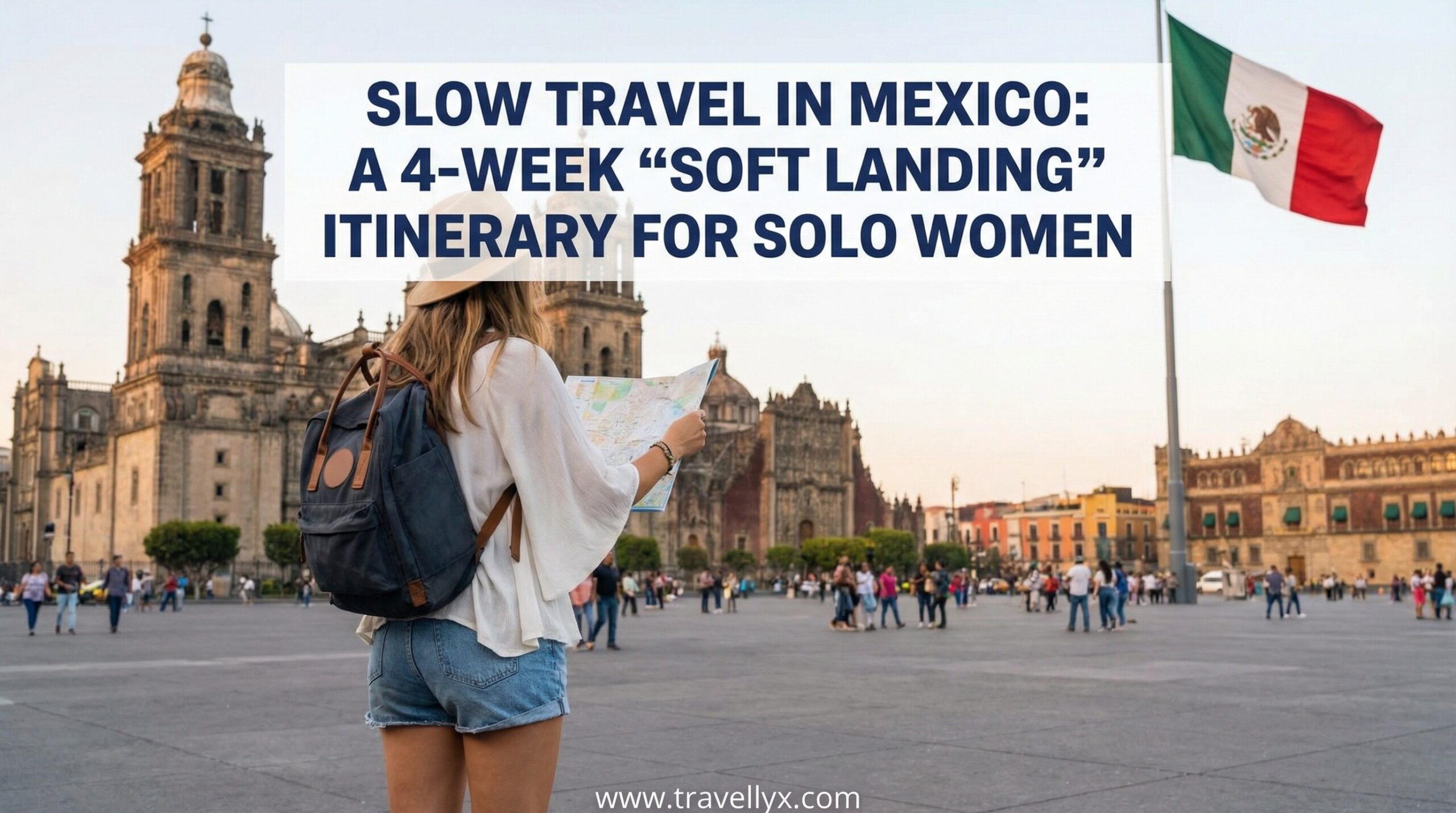
Slow Travel in Mexico: A 4-Week “Soft Landing” Itinerary for Solo Women
Have you ever felt the pull to escape your routine and truly immerse yourself in a different culture, but worried about doing it safely and authentically as a solo woman? If you’re dreaming of trading your daily grind for colorful markets, Spanish lessons over cafe con leche, and the warm embrace of Mexican hospitality, you’re in the right place. This guide will show you exactly how to plan a 4-week slow travel experience in Mexico that prioritizes both safety and genuine cultural connection, designed specifically for women traveling alone.
What Is Slow Travel Mexico for Solo Women?
Slow travel in Mexico for solo women means choosing depth over breadth. Instead of rushing through ten cities in two weeks, you’ll settle into one or two carefully chosen locations for three to four weeks each. This approach transforms you from a tourist snapping photos at landmarks into a temporary resident who knows the best bakery, has a favorite yoga studio, and exchanges warm greetings with local shopkeepers. It’s the difference between visiting Mexico and experiencing it, and it’s actually much safer than the whirlwind tourist approach.
Why Slow Travel Is Safer for Solo Women Than Fast Tourism
Let’s address the elephant in the room. If you’ve researched travel to Mexico, you’ve likely encountered alarming headlines and travel warnings. While it’s true that certain areas require caution, the slow travel approach actually creates a natural safety network that typical tourism doesn’t provide.
When you stay in one neighborhood for three weeks instead of changing hotels every two nights, something remarkable happens. The woman at the corner store starts to recognize you. Your landlord checks in to make sure you’re settling in well. The waiter at your regular breakfast spot saves your favorite table. You’re no longer an anonymous tourist with a target on your back, you’re becoming part of the community fabric.
The Soft Landing Strategy
Think of your first month in Mexico as a “soft landing” rather than a vacation. You’re not trying to see everything or check off a bucket list. Instead, you’re creating a temporary home base where you can learn the rhythms of daily life, practice your Spanish in low-pressure situations, and build genuine connections with both locals and other travelers who’ve chosen the same path.
This slower pace also gives you time to develop street smarts specific to your location. You’ll learn which neighborhoods feel safest at different times of day, which transportation options work best, and how to carry yourself with the confidence of someone who belongs rather than the uncertainty of someone who just arrived.
The Three Best Destinations for Your Month-Long Mexico Stay
Not all Mexican cities are equally suited for solo women embracing slow travel. Based on safety ratings, infrastructure for long-term rentals, and the presence of established expat and digital nomad communities, these three stand out as ideal starting points.
San Miguel de Allende: Your Training Wheels Option
If this is your first time doing extended solo travel in Mexico, San Miguel de Allende offers the perfect introduction. This UNESCO World Heritage city in central Mexico combines colonial charm with a well-established international community. You’ll find English spoken widely in tourist areas, making those first nervous days much easier.
Why it works for solo women: San Miguel consistently ranks as one of Mexico’s safest cities. The compact, walkable historic center means you can navigate confidently on foot. The large expat community has created numerous women’s groups, book clubs, and social events specifically designed for newcomers.
What makes it special for slow travel: The city offers abundant opportunities to dive deep into culture. Take week-long cooking classes, study silversmithing with local artisans, or join a Spanish conversation group. Safe long-term rentals in Mexico are plentiful here, with many landlords accustomed to renting to solo women for month-long stays.
The reality check: San Miguel is more expensive than other Mexican cities and heavily touristed. You’ll encounter more Americans here than in most of Mexico. If you’re seeking an ultra-authentic Mexican experience, this might feel too comfortable. But for building confidence, it’s unbeatable.
Oaxaca City: For the Culture and Food Enthusiast
If San Miguel is the training wheels option, Oaxaca City is where you graduate to the real deal while still maintaining excellent safety standards. This southern Mexican city offers one of the country’s richest cultural experiences, renowned cuisine, and a thriving arts scene.
Why it works for solo women: Oaxaca has cultivated a welcoming atmosphere for solo female travelers through its many Spanish schools, cooking classes, and mezcal tastings that naturally facilitate social connections. The city is compact and walkable, with a slower pace than Mexico City but more authenticity than San Miguel.
What makes it special for slow travel: Living in Oaxaca for a month means you can take multi-week courses in traditional Zapotec weaving, attend local festivals, and explore the surrounding Pueblos Mágicos at a leisurely pace. The food scene alone justifies a month-long stay, with markets, street stalls, and family-run restaurants offering endless culinary education.
The reality check: English is less commonly spoken than in San Miguel, which is actually a benefit for cultural immersion but requires more effort initially. The elevation can be challenging if you have respiratory issues. And while generally safe, you’ll need to be more culturally aware here than in heavily touristed San Miguel.
Mérida: The Safe Haven for Heat Lovers
Consistently rated as Mexico’s safest city, Mérida in the Yucatán Peninsula offers peace of mind alongside colonial beauty, Mayan culture, and access to spectacular beaches and archaeological sites.
Why it works for solo women: Mérida’s safety statistics speak for themselves. The city has one of Mexico’s lowest crime rates and a visible police presence that never feels oppressive. The local culture is notably warm and protective, with a strong sense of community safety.
What makes it special for slow travel: A month in Mérida allows you to establish a base for exploring the entire Yucatán Peninsula. Take day trips to cenotes, beaches, and Mayan ruins, but return each night to your comfortable apartment and familiar neighborhood. The city’s growing community of remote workers and slow travelers means you’ll easily find your tribe.
The reality check: The heat and humidity are intense year-round. If you’re not a fan of tropical climates, this might be challenging. The city is also more spread out than San Miguel or Oaxaca, so you might rely more on taxis and buses rather than walking everywhere.
Your 4-Week Soft Landing Itinerary
This week-by-week framework works regardless of which city you choose. Adjust the specifics to your destination, but follow this general progression from settling in to living like a local.
Week One: Getting Oriented and Feeling Safe
Accommodation strategy: Book a hotel or guesthouse for your first three to five nights. This gives you time to scout neighborhoods in person before committing to a month-long rental. Look for accommodations in central, well-reviewed areas for these first nights.
Your daily focus: Spend these first days walking your neighborhood during different times of day. Note which streets feel comfortable, where locals shop for groceries, and where expats gather for coffee. Most importantly, locate the essentials: the nearest ATM, pharmacy, grocery store, and reliable taxi stand.
Social connections: Join at least one organized activity this week, whether it’s a walking tour, cooking class, or language exchange. This gives you immediate social contact and helps combat any loneliness or anxiety that often hits on days three or four of solo travel.
Practical tasks: Get a local SIM card, set up your apartment for the remaining three weeks, and establish a morning routine. Maybe that’s coffee at a particular cafe, a walk to a specific park, or yoga at a nearby studio. Routine creates comfort and safety.
Week Two: Deep Dive into Culture and Learning
Your focus this week: Now that you’ve settled in, it’s time to engage deeply with what makes your chosen city special. In San Miguel, that might mean signing up for an art class. In Oaxaca, a cooking workshop. In Mérida, perhaps a course on Mayan history or salsa dancing.
Social expansion: By week two, you should be attending at least three social activities per week. Join the local chapter of Girl Gone International or Internations if they exist in your city. Attend language exchange nights. Say yes to invitations from people you met in week one.
Becoming a regular: Choose two or three establishments to frequent repeatedly. A cafe where you’ll work or read, a restaurant where you’ll eat lunch twice a week, a market stall where you’ll buy fruit. These relationships are the heart of slow travel. The recognition and warm greetings transform your experience from lonely to connected.
Spanish practice: By now you should be attempting basic Spanish daily, even if you’re terrible at it. Order in Spanish, ask directions in Spanish, greet shopkeepers in Spanish. The effort matters more than accuracy, and you’ll be surprised how much you pick up through immersion.
Week Three: Exploring Beyond Your Base
Day trip time: With your home base established and your confidence built, week three is perfect for exploration. Each of the recommended cities offers spectacular day trips that let you return to your comfortable apartment each evening.
From San Miguel: Visit the Cañada de la Virgen archaeological site, explore the hot springs of Atotonilco, or take a wine tasting tour in the nearby Valle de San Miguel.
From Oaxaca: Journey to the ancient ruins of Monte Albán, swim in the mineral springs of Hierve el Agua, or explore the artisan villages of Teotitlán del Valle and San Bartolo Coyotepec.
From Mérida: Visit the pink flamingos of Celestún, swim in cenotes like Ik Kil or Suytun, explore the archaeological wonders of Chichen Itzá or Uxmal, or spend a day at the beach in Progreso.
The slow travel difference: Because you’re based in one location, you can take these trips on any day that strikes your fancy. Bad weather? Stay home and work on your Spanish. Feeling tired? Take a rest day. This flexibility removes the pressure that makes traditional tourism exhausting.
Week Four: Living Like a True Local
Your evolved routine: By week four, you should have a established weekly rhythm. You know which days the best market happens. You have standing plans with friends you’ve made. The fruit seller asks about your weekend. This is the magic of slow travel in Mexico for solo women.
Giving back: Consider volunteering for a day or two. Many cities have organizations that teach English to local children, support women’s cooperatives, or work on environmental projects. This deepens your connection and gives you purpose beyond tourism.
Reflection and planning: Use this final week to process your experience. Many women find that one month of slow travel leads to a desire for more. If that’s you, start researching your next destination while you still have the network and knowledge you’ve built.
Saying goodbye: The hardest part of slow travel is leaving. You’re not just leaving a hotel, you’re leaving a temporary home and community. Take time to say proper goodbyes, exchange contact information, and acknowledge that you’ve just done something remarkable.
Finding Safe Long-Term Rentals in Mexico
The right accommodation can make or break your slow travel experience. Here’s how to find safe, comfortable month-long rentals that won’t drain your budget.
Where to Search
- Airbnb: The most straightforward option for month-long stays. Use the monthly discount filter and read reviews carefully, focusing on comments from other solo women. Book something with a flexible cancellation policy for your first experience.
- Local Facebook groups: Join expat groups for your chosen city months before you arrive. Search terms like “San Miguel Housing” or “Oaxaca Expat Rentals” will connect you with landlords who regularly rent to foreigners and understand what solo women need.
- Furnished Finder: Originally designed for traveling nurses, this site has expanded to include Mexico and offers excellent furnished monthly rentals.
- Local real estate offices: Once you arrive and have spent a few days in temporary accommodation, visit local rental agencies. Many properties never make it online and you can negotiate better rates in person.
Safety Red Flags to Avoid
- Properties that require full payment upfront before you’ve seen them
- Rentals far from central neighborhoods or poorly connected by public transport
- Places with unclear or absent lock situations on doors and windows
- Properties with consistently poor reviews about safety or landlord responsiveness
- Deals that seem too good to be true (they probably are)
For peace of mind, especially on your first slow travel experience, prioritize properties in buildings with other tenants, security features like gated entries or doormen, and locations where you can walk to amenities during daylight hours. An extra hundred dollars per month for better security is money well spent.
Building Your Social Safety Net
One of the biggest concerns women have about solo travel in Mexico isn’t physical safety, it’s the fear of loneliness or not having support if something goes wrong. The beauty of choosing established slow travel destinations is that robust social networks already exist, you just need to tap into them.
Women’s Travel Groups and Resources
Girl Gone International: This global organization has active chapters in San Miguel, Oaxaca, and Mérida. Monthly meet-ups, WhatsApp groups, and regular social events connect you instantly with other women living abroad.
Facebook groups to join before you leave: Search for “Women in [your city]”, “Expat Women [your city]”, or “Digital Nomad Women [your city]”. Introduce yourself a few weeks before arrival and you’ll likely receive offers to meet for coffee when you land.
Language schools: Beyond teaching Spanish, language schools serve as instant social hubs. Most organize cultural activities, conversation clubs, and social events where you’ll meet both locals and other foreigners in similar situations.
Cooking classes and workshops: Multi-day cooking intensives or craft workshops create natural friendships. You’re spending extended time with the same small group, working toward a common goal, which accelerates bonding.
The key is to line up at least two or three social activities before you even arrive. Having something on your calendar for days two, four, and six of your trip means you won’t spiral into loneliness during those vulnerable early days.
Essential Practicalities for Month-Long Mexico Itinerary
Budget Expectations
Living in Mexico for a month costs significantly less than you might expect, especially compared to Western countries. Here’s a realistic monthly budget for each city, including everything:
- San Miguel de Allende: 1,800 to 2,800 USD (rent: 800 to 1,500 USD, food and activities: 1,000 to 1,300 USD)
- Oaxaca City: 1,500 to 2,300 USD (rent: 600 to 1,100 USD, food and activities: 900 to 1,200 USD)
- Mérida: 1,400 to 2,200 USD (rent: 550 to 1,000 USD, food and activities: 850 to 1,200 USD)
These ranges assume a comfortable lifestyle with a nice one-bedroom apartment, eating out regularly, taking classes, and enjoying activities. You can absolutely do it cheaper with cooking at home more often, choosing a simpler apartment, or selecting less expensive activities.
Health and Safety Essentials
Before you leave, ensure you have comprehensive travel insurance that covers medical care in Mexico. Many credit cards offer some trip protection, but verify the details carefully. Companies like World Nomads or Safety Wing specialize in long-term travel insurance that’s perfect for slow travel scenarios.
Each of your chosen cities has excellent private medical care. Research the top hospitals before you arrive and save their contact information. Most doctors in these cities speak English and consultations cost a fraction of what you’d pay at home.
Register with your embassy once you arrive and keep their contact information handy. While you likely won’t need them, knowing they’re there provides peace of mind. You can also check the latest safety information at the U.S. State Department travel advisory page.
Communication and Staying Connected
Your first stop after landing should be an OXXO convenience store or a Telcel office to get a Mexican SIM card. Telcel offers the best coverage nationwide, while AT&T Mexico provides better data speeds in cities. A monthly plan with unlimited calling and plenty of data runs about 300 to 500 pesos (15 to 25 USD).
Having a local number is crucial for safety, booking accommodations, ordering transportation, and communicating with new friends. It transforms your phone from a tourist device to a resident tool.
What to Pack for Your Month in Mexico
Packing for a month-long stay differs significantly from packing for a week-long vacation. You need less than you think, but what you bring should be versatile and high quality.
The Essential Packing List
- Clothing: One week’s worth of mix-and-match outfits suitable for both casual exploration and nicer restaurants. Include layers for air conditioning. You’ll do laundry weekly, so more clothes just mean more to carry.
- Footwear: Comfortable walking shoes, sandals for hot weather, and one pair of nicer shoes for evenings out. Many Mexican cities have cobblestone streets, so save the heels for home.
- Technology: Laptop if you work remotely, phone, universal adapter, portable charger, and quality headphones. Consider a Kindle loaded with books rather than packing physical copies.
- Safety items: Door stop alarm, photocopy of your passport, list of emergency contacts, and a credit card separate from your wallet. Keep your actual passport in your accommodation’s safe.
- Comfort items: Your favorite tea or coffee if you’re particular, prescription medications with extra supply, and one or two items that make any place feel like home, maybe a favorite scarf or a small photo.
- Don’t pack: Hair dryer (your apartment will have one or you can buy cheaply), full-size toiletries (buy locally, it’s part of the experience), or excessive clothing (laundry is inexpensive and readily available).
Staying Safe: Real Talk About Mexico Security
Let’s address this directly because it’s likely your biggest concern and possibly what’s holding you back. Yes, Mexico has areas with security concerns. No, the cities recommended in this guide are not among them when you take reasonable precautions.
The reality of safety for solo women in Mexico is far more nuanced than news headlines suggest. Millions of women live and travel safely throughout Mexico every year, including in the cities mentioned here.
Practical Safety Guidelines
- Use authorized taxi services or apps like Uber and DiDi, especially at night. Never flag down random taxis on the street.
- Keep expensive jewelry at home. Blend in rather than standing out as a wealthy tourist.
- Trust your instincts. If a situation or place feels wrong, leave. Your intuition is your best safety tool.
- Avoid excessive alcohol consumption, especially when alone or with people you just met.
- Keep your phone charged and share your location with trusted friends or family back home through apps like Find My Friends.
- Learn basic Spanish phrases for emergencies: “Necesito ayuda” (I need help), “Llame a la policía” (Call the police).
- Stay informed about your specific neighborhood through local expat groups, but don’t let fear-mongering paralyze you.
The slow travel approach inherently increases your safety. You’re not wandering lost with a map, you know your way around. You’re not carrying all your belongings, most are secure in your apartment. You’re not obviously a tourist, you’re someone who lives here temporarily. This confidence and familiarity naturally reduce your vulnerability.
For more comprehensive safety guidance, check out this resource on safe travel for solo women in Latin America, which includes helpful tips applicable to Mexico as well.
The Best Pueblos Mágicos for Solo Females
Mexico’s Pueblos Mágicos (Magical Towns) program designates communities with special cultural, historical, or natural significance. Several make perfect additions to your month-long stay, either as day trips or as week-long extensions if you want to explore beyond your main base.
Accessible from San Miguel de Allende
Dolores Hidalgo: The birthplace of Mexican independence, this charming town is just 40 minutes from San Miguel. Known for its Talavera pottery and unusual ice cream flavors, it’s a perfect day trip that feels authentically Mexican without tourist crowds.
Mineral de Pozos: A former silver mining town turned artistic haven. The ruins of old haciendas and mines create a hauntingly beautiful landscape. Several women artists have established workshops here, and the small-town atmosphere feels incredibly safe.
Accessible from Oaxaca City
San Pablo Villa de Mitla: Ancient Zapotec ruins meet living indigenous culture in this special town. The geometric patterns in the pre-Hispanic buildings are unlike anything else in Mexico. Women’s weaving cooperatives welcome visitors, offering both purchases and workshops.
Mazunte: While technically a beach town rather than a mountain pueblo, this laid-back coastal village offers yoga retreats, turtle conservation projects, and a notably welcoming vibe for solo women. Consider spending a few days here during your Oaxaca month.
Accessible from Mérida
Valladolid: This colonial city serves as the perfect base for exploring nearby cenotes and Chichen Itzá without the crowds of Cancun. The central plaza comes alive at night with locals, not tourists, creating authentic experiences.
Izamal: The yellow city, painted entirely in golden yellow and white, offers a fairy-tale atmosphere. It’s small enough to explore thoroughly in a day but charming enough that you might want to stay overnight in one of the boutique hotels.
Creating Your Daily Rhythm
The magic of slow travel emerges not from what you see, but from how you live. Establishing a daily rhythm that combines comfort, adventure, and cultural immersion makes the difference between merely staying somewhere for a month and truly experiencing it.
Most successful slow travelers develop a framework that looks something like this: productive or learning time in the morning, cultural immersion in the afternoon, and social connection in the evening. But your perfect rhythm might look completely different, and that’s the point. You have the luxury of experimenting.
Sample Daily Rhythm (Week 2 Onward)
Morning (7am to 11am): Start with coffee at your regular cafe where the barista knows your order. Work on your laptop if you’re remote working, or attend a Spanish class. Return to your apartment for a light lunch you’ve prepared from market ingredients.
Afternoon (11am to 5pm): This is for cultural exploration. Visit a museum, take a cooking class, explore a new neighborhood, or simply read in a park. The key is intentional engagement with where you are, not passive tourism.
Evening (5pm to 9pm): Social time. Meet friends you’ve made for dinner, attend a language exchange, take a salsa class, or simply enjoy people-watching at a plaza. Mexican evening culture is rich and welcoming.
Night: Early enough bedtime to do it all again tomorrow. Slow travel isn’t about partying until dawn, it’s about sustainable, enriching daily living.
Handling Common Challenges
Even the best-planned slow travel experience encounters bumps. Here’s how to handle the most common challenges solo women face during extended Mexico stays.
Loneliness in Week One
Almost every solo traveler experiences a low point around day three or four. You’re tired from travel, everything is unfamiliar, and you haven’t yet made connections. This is normal and temporary. Push through by attending at least one social event, even when you don’t feel like it. Call home if you need to. Remember that by week two, this feeling will have completely transformed.
Language Frustration
Communicating in basic Spanish feels vulnerable and exhausting at first. You’ll have moments of frustration when you can’t express yourself or understand what’s being said. Embrace it as part of the growth process. Carry a translation app, laugh at your mistakes, and celebrate small victories. By week three, you’ll be amazed at how much you’ve absorbed through immersion.
Cultural Differences
Mexican culture operates on a different timeline than many Western countries. Things that would happen quickly at home take longer. Plans change at the last minute. Your landlord might not respond to messages as quickly as you’d like. Rather than seeing this as inefficiency, try embracing it as a different approach to time and relationships. This flexibility and human-centered approach is part of what makes Mexico special.
Missing Home
At some point, you’ll desperately crave something from home, whether that’s a particular food, a familiar TV show, or just speaking your native language without thinking. This doesn’t mean you’re not cut out for slow travel, it means you’re human. Schedule video calls with family, find a restaurant that serves food from your home country, or spend an evening binge-watching familiar shows. Then get back out and re-engage with Mexico.
Frequently Asked Questions
Making the Decision to Go
If you’ve read this far, you’re seriously considering slow travel in Mexico for solo women. The planning and preparation might feel overwhelming, but remember that thousands of women before you have successfully navigated this journey. The infrastructure exists, the communities are welcoming, and the rewards far exceed the challenges.
The hardest part is making the decision and booking that first ticket. Once you’re committed, the details fall into place. Your concerns about safety, loneliness, and capability will likely seem overblown once you’re actually there, living your daily life in a beautiful Mexican city, practicing Spanish with the fruit vendor, and making dinner plans with new friends.
Slow travel in Mexico offers something increasingly rare in our modern world: the chance to genuinely disconnect from your usual life and immerse yourself in a different culture at a human pace. You’re not escaping your life, you’re expanding it. You’re not running away from responsibilities, you’re choosing to prioritize personal growth and cultural understanding.
Your Next Steps
- Choose your city: Based on your priorities (safety, culture, cost, or climate), select your starting point. Remember, you can always return for another month in a different city later.
- Pick your dates: Allow at least two to three months for planning. This gives you time to research, save, and join online communities for your destination.
- Book your first week: Secure accommodation for your first five nights in a well-reviewed hotel or guesthouse in a central location. Don’t commit to a monthly rental until you’ve seen options in person.
- Join Facebook groups: Connect with expat and women’s groups for your destination city now. Introduce yourself and ask questions. You’ll get invaluable current information and possibly invitations to meet up when you arrive.
- Arrange travel insurance: Don’t skip this. Get comprehensive coverage that includes medical care, evacuation if necessary, and trip interruption protection.
- Start learning Spanish: Even 20 minutes daily on an app like Duolingo will give you a foundation that makes those first days much easier.
The truth about slow travel in Mexico for solo women is this: it’s one of the most transformative, confidence-building, and enriching experiences you can give yourself. You’ll return home not just with photos and stories, but with a fundamentally expanded sense of what’s possible in your life. You’ll have proven to yourself that you can navigate unfamiliar territory, build community from scratch, and thrive independently in a different culture.
That confidence doesn’t stay in Mexico. It comes home with you and influences every area of your life going forward. You’ll never again wonder if you’re capable of handling challenges, because you’ll have proven that you absolutely are.
So start planning. Join those Facebook groups. Book that initial accommodation. Begin this incredible adventure. Mexico is waiting to welcome you, and a month from now, you’ll be wondering why you waited so long to begin.