Boeing 737 Weight Error: Qantas Flight Misses 50+ Passengers in Calculations
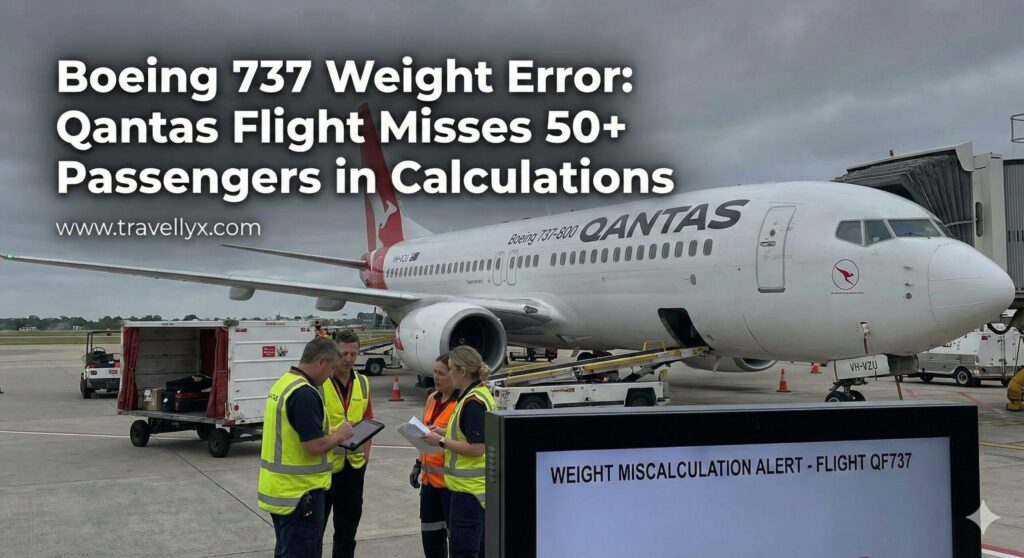
Have you ever sat on a runway, waiting for takeoff, and wondered just how much math goes into getting a massive metal tube into the sky? We trust that the numbers are right. But recently, a serious Boeing 737 weight error caught the world’s attention. A Qantas flight took off with a miscalculation so significant that more than 50 passengers were essentially “invisible” to the flight computer. If you are looking for the details on how this happened, why it matters, and if you are safe to fly, you have come to the right place. We are going to break down this incident simply and clearly.
🚀 Quick Summary
A Qantas Boeing 737-800 departed with a takeoff weight that was calculated incorrectly. The error omitted a large group of passengers, meaning the pilots used data for a plane that was much lighter than it actually was.
The Incident: What Exactly Happened?
Imagine trying to lift a heavy box, but you think it’s empty. You might not pull hard enough, and you might hurt your back. In aviation, this concept is called “Performance Calculation.”
On the flight in question, a misunderstanding occurred regarding the passenger manifest. Reports indicate that a group of passengers—often cited in similar incidents as school children or a large tour group—was not correctly tallied in the final weight load sheet. This resulted in the Boeing 737 weight error.
The pilots entered data into the onboard computer assuming the plane was several tonnes lighter than reality. When you miss 50+ passengers, plus their carry-on bags, you are looking at a discrepancy of roughly 4,000 to 5,000 kilograms (4-5 tonnes).
[Image of Boeing 737 takeoff diagram]Why Does Weight Matter So Much?
You might be thinking, “The plane is huge; does a few tonnes really matter?” The answer is a resounding yes. Weight changes everything about how a plane flies, specifically during the most critical phase: takeoff.
The Three Magic Numbers
Pilots calculate three specific speeds based on weight:
V1 (Decision Speed): The point of no return.
Vr (Rotation Speed): When to pull back on the stick to fly.
V2 (Safety Speed): The speed needed to climb safely if an engine fails.
If the computer thinks the plane is light, it will give the pilots lower speeds. If the pilot tries to lift the nose (rotate) at a speed that is too slow for the actual heavy weight of the plane, the wings might not generate enough lift. This can lead to a tail strike (dragging the tail on the runway) or, in worst-case scenarios, the plane failing to climb.
How Could Qantas Miss 50 Passengers?
We often think of aviation as highly automated, but humans are still very much in the loop. This incident is a classic example of the “Swiss Cheese Model” of accident causation. This is where holes in different layers of defense line up to let an error pass through.
1. Manual Data Entry
Despite modern technology, changes to the passenger list sometimes require manual inputs. If a gate agent or load controller manually edits a group of passengers but selects the wrong code (for example, marking them as “freight” instead of “pax” or simply failing to save the update), the final number drops.
2. Last-Minute Changes
Flight manifests change rapidly right up until the doors close. If 50 passengers from a cancelled connecting flight are added at the last minute, that data has to move from the check-in desk to the load controller and finally to the pilots. Somewhere in that chain, the communication broke down.
⚠️ The Human Factor
In almost all Boeing 737 weight error incidents, the aircraft itself was working perfectly. The “glitch” was actually a human mistake in data processing.
The Safety Net: Why Didn’t It Crash?
This is the most important part for nervous flyers. Even though the calculation was wrong, the plane landed safely. Why? Because aviation is built on huge margins of safety.
Boeing engineers and airline regulators know that humans make mistakes. Therefore, they design the takeoff performance to have a “buffer.”
- Runway Length: Pilots rarely use the absolute minimum runway length needed. There is usually extra pavement left over.
- Engine Thrust: Engines are rarely pushed to 100% power for normal takeoffs to save wear and tear. However, if the pilot realizes the plane feels “heavy” and sluggish, they can instantly push the throttles to maximum power.
- Pilot Skill: Experienced pilots can “feel” the aircraft. If the nose doesn’t lift when it’s supposed to, their training kicks in to correct the situation immediately.
Industry Reaction: Fixing the Problem
When a Boeing 737 weight error happens, it triggers an immediate investigation. It’s not just about blaming someone; it’s about changing the system so it cannot happen again.
Following this Qantas incident, several changes were likely reviewed:
- Automated Cross-Checks: Systems that flag large discrepancies between checked-in passengers and the load sheet.
- Digital Load Sheets: Moving away from paper or manual voice radio updates to direct digital uploads to the cockpit.
- New Protocols: Stricter rules on how large groups are processed in the system.
What This Means for Your Next Flight
Reading about a Boeing 737 weight error can be scary, but it actually highlights how robust the system is. The error happened, the calculation was wrong, and yet the safety buffers absorbed the mistake. The plane flew, and everyone arrived safely.
Airlines like Qantas generally have impeccable safety records. They use these incidents as learning opportunities. Today, the software used to calculate weight is smarter than ever, often creating a “sanity check” that warns pilots if the weight looks suspiciously low compared to the number of booked seats.
Frequently Asked Questions
While safety margins were reduced, the flight was not in immediate danger of falling out of the sky. The Boeing 737 has enough excess power to handle discrepancies like this, provided the runway isn’t extremely short.
No, this is a rare occurrence. Millions of flights take off every year with perfect weight calculations. Significant errors like missing 50+ passengers are statistical outliers.
Airlines don’t weigh you individually. They use “standard average weights” set by regulators. For example, an adult might be calculated as 84kg (including carry-on). These averages are conservative to ensure safety.